Case study
Establishing the Social Welfare Alliance in the London Borough of Newham
The problem we faced
Amid the first coronavirus lockdown, Newham Council realised many residents were falling into deprivation. Some were struggling to afford food and others were at risk of becoming homeless.
Queues at food banks were doubling each week. Many in gig jobs and casual employment went in an instant from a reliable income to being out of a job without a chance of being furloughed.
It was immediately clear that people’s needs stretched far beyond getting access to a hot meal. They needed help applying for benefits, finding employment, support with their mental health, new clothes, accommodation, help with their visa status, and in many cases, all of the above.
Many people felt more comfortable asking for help from community organisations than from the council. Newham recognised these organisations were pivotal. Working with and through community organisations, they had the opportunity to initiate and strengthen relationships with residents and to use these relationships to discover and support their wider needs.
Providing food created a starting point for a conversation. The question was, when someone arrived at a foodbank, how could practitioners build the relationship needed to begin to understand the complex range of problems that weren’t visible on the surface?

How we helped
Within this context, we helped the council establish the Social Welfare Alliance. The Alliance brought together partners from across the public sector and voluntary, community and faith sectors to collaborate - with frontline workers across these sectors referred to collectively as “Social Welfare Advisors”, sharing a role of providing immediate support to residents.
As a group, we wanted to identify how we could maximise the assets that existed in the community. Working closely with colleagues in the council we aimed to ensure residents got the help and support they needed at the earliest possible stage, regardless of who they approached for help.
We did three things:
1. Build capacity among front-line workers in adopting a relational approach
We trained front-line staff from across sectors in “Core Conversations” - this was the origin of our Core Conversations training, which has now been undertaken by more than 400 professionals across the UK from Tower Hamlets Council to Save the Children.
Developed in partnership with community organisations, the training teaches evidence-based approaches that enable people working on the front line to adopt a relational approach.
By building deeper connections with residents we believed front-line workers would be better able to get to the root cause of their challenges (e.g. beyond the initial challenge of needing a hot meal).
We trained over 200 community workers as part of the project and together developed a series of principles practitioners can use to provide practical help, faster.
“
I will be using all of the examples in my day-to-day interactions with the vulnerable people I help" Founder & Director, Heal Together CIC
2. Build relationships between and shared knowledge of local support among community organisations
We used our experience as facilitation experts to help organisations develop bite-sized training modules on the support available for the biggest areas of need in the borough. Working with the council we coordinated the training programme, bringing people from a wide variety of partners together to learn and build connections with one another.
As part of these training sessions, we ensured there was time for delegates to meet their colleagues and get to know one another on a more personal level.
Because online information about the support available in the community was always changing and frequently out of date, we hypothesised that these relationships would enable partners to better navigate an imperfect system and help their clients more quickly. This hypothesis proved to be true.
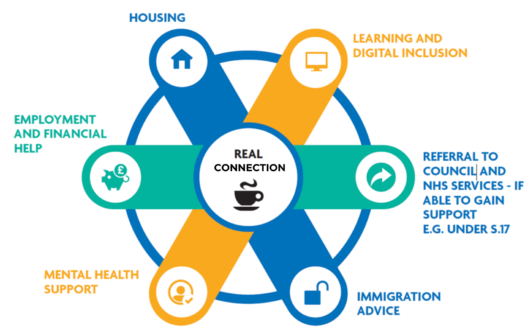
3. Established a means of communication across partners
We helped establish WhatsApp community channels to enable partners to collaborate. The channels were used to ask for and offer help and advertise opportunities relevant to different organisations and hyper-local communities.
Because group members had already met one and knew one another beyond just an email address, these channels were used extensively.
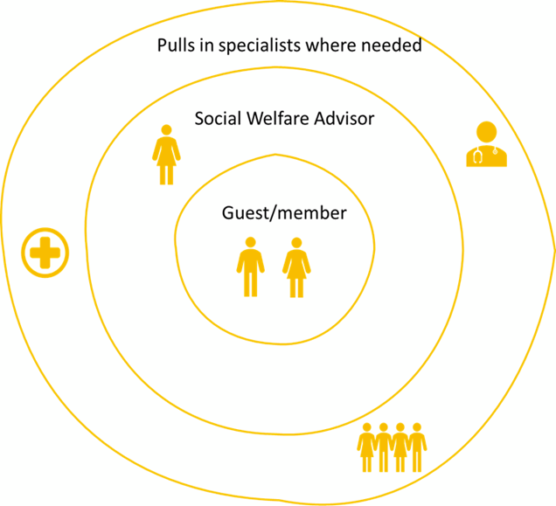
How these initiatives combined to create a better experience for residents
The outcomes
The approach enabled a rapid response to increasing needs during the initial wave of the pandemic and was subsequently rolled out in the London Borough of Hackney and recognised with a local government innovation award.
The project was also used as the basis to develop a "Preventing Residents from Reaching Crisis Toolkit" toolkit by London Office of Technology and Innovation, also available are recordings of show and tells from within the project process.
The work enabled a whole new approach to providing help to people with multiple complex needs, based on principles of “Food and More”, “Then and There Help”. Summing up the power of the Social Welfare Alliance, Project Lead Phil Veasey put it best: “The pandemic has taught us that these difficult issues in the borough have to be tackled in partnership. We can’t do this on our own. This is a systems issue, so let’s come together as a system to solve it.”
We think these ideas have wide application in a range of different contexts. If you’re interested in developing a social welfare alliance or exploring this approach further - get in touch.
Core Conversations Training was subsequently evaluated by University College London and found to be effective at enabling a more relational approach across services.
You too can deliver faster outcomes with lasting results
Secure your place to become an Agile Master by the Public Service Transformation Academy. Or get in touch by emailing us on comms@basis.co.uk