Case study
Unlocking income and cost savings for Hackney Council
“
This programme of work has demonstrated that by taking an agile approach, working collaboratively in an iterative way, has enabled us to progress a number of opportunities to support income for the Council. The leadership of Basis enabled the tricky, messy and complex issues to be unpicked and genuine options put forward to progress”
Geeta Subramaniam-Mooney, Director Environment and Climate Change, Hackney Council

The Situation
Like many local authorities across the UK, Hackney Council is facing significant budgetary pressures with a £67 million shortfall over three years at the time of this project.
The Director of the Environment and Climate, Geeta Subramaniam-Mooney, brought us in to help answer the question: how might we generate additional income and cost savings in a timely, efficient manner while continuing to deliver high quality services for residents?
The work focused on the following service areas:
- Parks
- Venues
- Markets and trading
- Street scene
- Waste collection and street cleansing
- Community safety and enforcement
Rather than carrying out a prolonged analysis of opportunities in isolation, we wanted to make this a highly collaborative process from the start with an emphasis on getting into action as soon as possible. This involved dynamic workshops so that we could deeply understand Hackney’s context and co-develop ideas alongside service leads. We also set up a dynamic working rhythm to ensure relevant colleagues were engaged at every step of the process. To gain momentum quickly, we agreed a laser focus on parks, green spaces and venues before progressing to other service areas later in the project.

Getting started and breaking down barriers
When we first started engaging with the service leads, there were significant barriers to getting started. Alongside valid concerns about commercialising public spaces, there was significant fatigue from previous analysis on this topic that had never fully progressed into action.
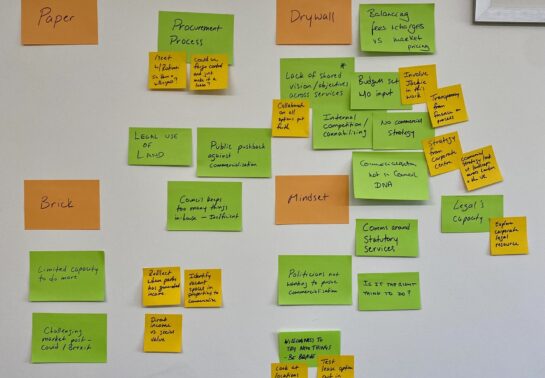
We began by facilitating a workshop to build a shared understanding of the barriers that have held previous efforts back. This collaborative session was crucial for identifying which barriers were real blockers and which could be overcome with dedicated effort. This led to a list of actions from collaborating with procurement to developing a unified approach to income generation across service areas that allowed us to quickly start addressing barriers in practice.
Following the workshop, we set up an agile working rhythm with the relevant service leads. Rather than going off and writing the recommendation report in isolation, we did a show and tell with them every two weeks. These sessions were an opportunity to share what we had found and test ideas with them then and there. This helped ensure the report was co-developed with those actually responsible for delivering the work.
This agile, collaborative process allowed us to continuously develop, test and refine ideas over time, transforming a long list of possibilities into a set of concrete proposals ready for delivery. We also co-developed a rigorous set of criteria that balanced potential income with the projected social impact on areas like community well-being and biodiversity, which was critical for progressing proposals with council leadership.
Getting buy-in from senior leaders and Members
As the recommendation report took shape, we needed to get approval from senior leadership as well as political support from Members.
To ensure the proposals were robust and fully aligned with the Council’s wider priorities, we first presented them to the relevant corporate directors. This alignment stage was crucial for incorporating their strategic feedback before we scheduled a workshop with the Mayor and relevant Members for formal approval.
Recognising that the Mayor and Members had limited time, we facilitated a highly focused session designed for efficient, clear decision-making. Our structured approach ensured that all feedback was captured and addressed systematically so that we could quickly get to decisions on each proposal without getting bogged down in the details.
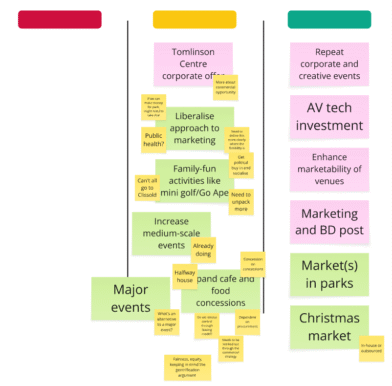
For each proposal we used a stoplight approach: Green (go ahead, no concerns), Yellow (supportive with some concerns), Red (no go). This simple, visual tool was highly effective, with nearly every proposal earning a Green or Yellow light and a clear set of actions to address any outstanding concerns.
The Corporate Director for Climate, Homes and Economy said:
“This meeting was very effective for getting clear decision-making and political buy-in so that we could start delivering with confidence.”
Sustaining momentum and delivering at pace
With full support from leadership and Members, it was time to start delivering the approved list of opportunities.
Instead of each service lead delivering in isolation, we organised an income generation and savings forum that met once a month. In the spirit of agile, the forum meetings focused on three key questions: What have you done? What are you doing next? And, is there anything getting in the way?
Similar to the development of the recommendation report, the savings and income forum created a collaborative space for all service leads to share progress, discuss ideas and have full transparency of what everyone is working on. At the time of writing, the forum had met for eight consecutive months and achieved considerable progress in that span.
The Impact
The savings and income programme within Hackney’s climate and environmental services is an ongoing piece of work that continues to deliver results for the Council’s financial sustainability. Here are some of the impact that has been achieved so far:
You too can deliver faster outcomes with lasting results
Secure your place to become an Agile Master by the Public Service Transformation Academy. Or get in touch by emailing us on comms@basis.co.uk