Case study
Building Service Design Capability
“
Working in a group setting and incorporating a simulation was a good way to learn by experience. I came away with a lot of points for reflection about how I'd apply this more broadly in future work.
Maame Baryeh, Bi-Borough
The challenge
I
After two busy years of dealing with the impact of the pandemic, the transformation, commissioning and programme teams at the Royal Borough of Kensington and Chelsea, hadn’t had much opportunity to reflect on their practice. We’ve run a lot of training with these boroughs in the past, and when asked if we could design and deliver service design training, we were excited to help.
To make sure we met the brief, we asked Justine May, Head of Children's Transformation and Innovation, who commissioned the training, to articulate their need in the form of a User Story. Here's what she came up with...
“When presented with new projects or savings requirements, WE WANT the team to be equipped with skills and confidence to understand how to pinpoint drivers for issues and work collaboratively across the system SO THAT we deliver change in a way that is innovative, collaborative and impactful.”
Justine May
Head of Children's Transformation and Innovation
How we created our training programme
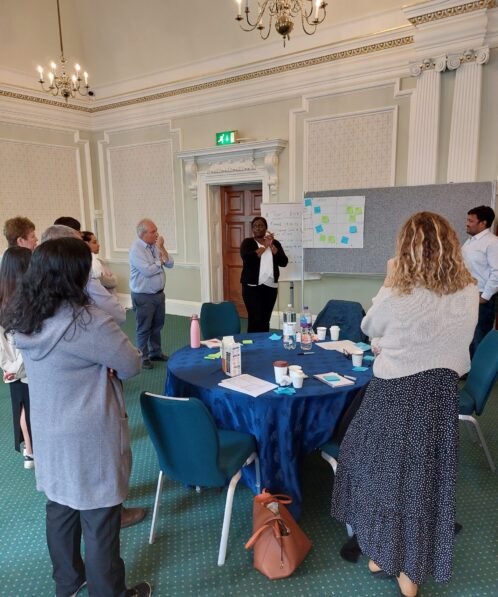
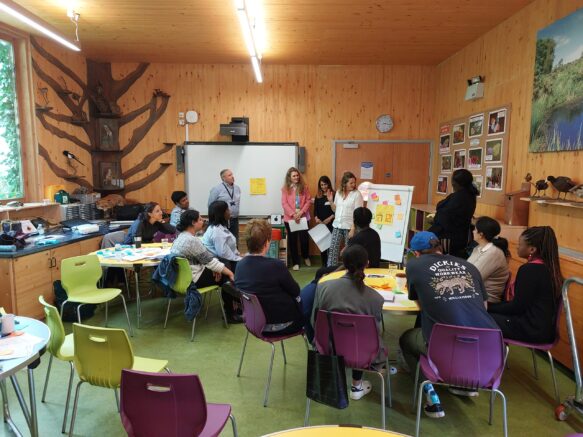
We created a three-day in-the-room training programme, which covered the different stages of change implementation and applied a user-centred approach. Each day focused on a different aspect. The first day focused on Understanding the Problem from the User’s Perspective, the second day on Designing Tangible Solutions and the final day on Implementing Change.
Putting learning into practice
When designing all of our training, we always aim to give just enough theory to empower participants to try the learning out in practice. We went a little bit OTT on the ‘putting learning into practice’ bit as part of this training. We designed a fictitious council (with its own logo and staff) with the worst recycling rates in the country (with actual performance data and complaints to back it up). The data helped them find issues, for instance, the borough had a large number of high-rise social housing properties. The logistical challenge of recycling within these buildings was compounding their recycling problem. In this scenario, our participants were seconded in to help the council understand the root cause of their recycling problem, to design and test solutions and then make them happen.
We worked hard in the design of this simulation to create as much detail as possible so that the participants could really immerse themselves. The Basis team would transform to play key characters in this simulation, namely the Head and Transformation (under whom the participants would be working) and the Head of Waste Management (who is resistant to change),
as well as users such as Tina Foil (a keen recycler) and Gary Bidge (a belligerent non-recycler). We created the details and layout of a fictional tower block, Tetra Pak Tower, and the user journeys and user personas of some of its inhabitants. We produced a ton of materials to give participants the data they needed: demand data, council structure charts, internal emails and more. We even made a logo for Wasteborough and Binbury Borough Council, which was absolutely unnecessary.
Choosing a neutral scenario
We chose to design this simulation around recycling because we saw it as a ‘safe-to-play area’. Play is an important part of our learning programmes. While a children’s social care simulation would have been more relevant, it wouldn’t have been possible to play in this context. Recycling is relatively neutral and everybody has some lived experience (good or bad), which they can bring to the training.
Here's a rundown of what happened over the course of the training
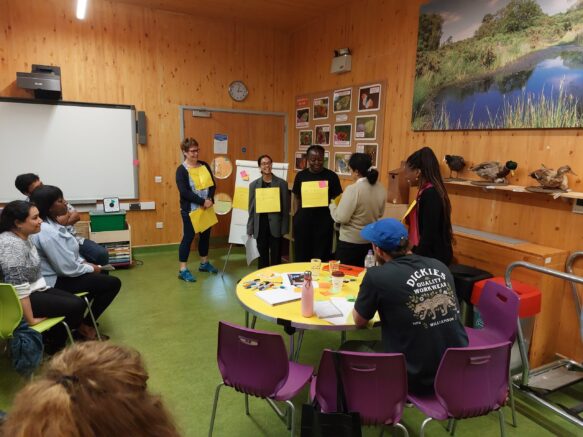
Day 1: Understanding the Problem from the User’s Perspective. Participants were introduced to Wasteborough and Binbury Borough Council. Participants learned how to distinguish value from failure demand and explored a range of user-research approaches. Around midday, we unleashed newly formed teams to put their learning into practice on Wasteborough. At the end of the day, each team gave a show and tell, presenting their work and defining the problems they had encountered in the form of ‘How Might We’ statements.
Day 2: Designing Tangible Solutions. We covered a range of ways to come up with and develop solutions to public sector challenges. There were some key chunks to cover, the basics of co-production, a range of ideation techniques and how to use positive deviance to identify great ideas from within the services. In the afternoon, teams tested these methods in Wasteborough. They also collaborated with users to iterate on their ideas.
Day 3: Implementing Change. Participants learned about working in an agile way to implement change. Conflict and friction inevitably arise on complex projects, so they practised productive reasoning as a tool to overcome this challenge. We ended the training with a big show and tell, where the teams presented their implementation plans alongside their lessons from the training.
What impact did the training have?
During the end of training reflections, it was great to hear from the participants what they had learned from the experience, and how they intended to apply this to their work. We were thrilled to see how much fun the participants seemed to have had too. They really threw themselves into the simulation and learnt a whole lot as a result.
Even better was to see the learning applied in practice. Following the training we coached three members of the team who were working on complex change projects.
Natalia and Jess were working on a project to ensure high-cost placements for looked-after children were meeting needs and offering value for money.
The service had a hunch that with better communication between the placements team, independent reviewing officers and social workers they could more effectively respond to the changing needs of children and young people and reduce the amount spent on placements when intensive support is no longer required.
Building on the methods we taught in the training we coached the team to run a design sprint with practitioners involved in end to end process. Over the course of two days, the team designed a new approach to collaboration across teams and then prototyped it with real cases over the next two weeks. Within the two-week period, the team were able to reduce spend on intensive support, which was no longer needed and/or being utilised, for two young people in placements. This alone has saved the service £32,000. Based on this early success the team are now planning on scaling the prototype.
"I think it is great for people who would not normally work as a team as this training requires collaboration. I found that although we all looked at the same question our answers and solutions were so different. It is thought provoking and makes you think out of the box!!"
Lorraine Clarke, Bi-borough
Quotes from staff who attended the training
If you think our Service Design Training might be the right fit then get in touch! Find out more on our
You Tube channel here
You too can deliver faster outcomes with lasting results
Secure your place to become an Agile Master by the Public Service Transformation Academy. Or get in touch by emailing us on comms@basis.co.uk